Blog
Multi-Needle vs Single-Needle Embroidery Machines

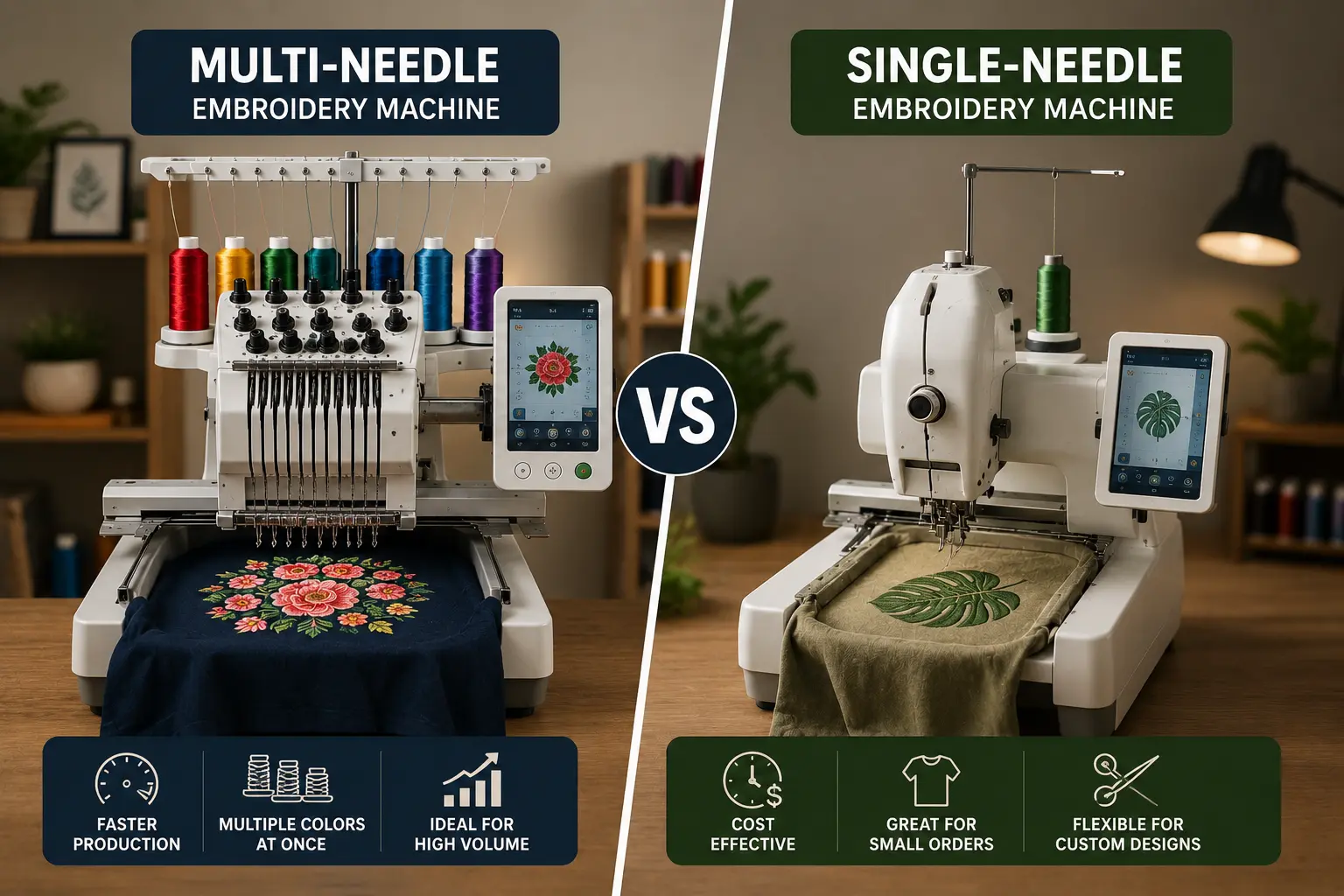
Embroidery machines have completely changed the way businesses create custom apparel, hats, uniforms, and promotional products. Whether you are starting a small embroidery business or looking to upgrade your current setup, one of the biggest decisions you will face is choosing between a multi-needle embroidery machine and a single-needle embroidery machine.
Both machine types have their own advantages, limitations, and ideal use cases. Understanding the differences can help you choose the right machine based on your budget, production needs, and business goals.
In this guide, we will compare multi-needle and single-needle embroidery machines in detail, including their features, benefits, disadvantages, costs, and which option is best for different types of embroidery businesses.
What is a Single-Needle Embroidery Machine?
A single-needle embroidery machine uses one needle at a time to stitch designs. These machines are commonly used by beginners, hobbyists, and small businesses that handle lighter embroidery workloads.
Whenever a design requires multiple thread colors, the machine pauses so the operator can manually change the thread before continuing.
Single-needle machines are usually compact, affordable, and easier to learn, making them a popular starting point for new embroidery businesses.
Key Features of Single-Needle Machines
- Uses one needle and one thread color at a time
- Manual thread changes for multi-color designs
- Compact and beginner-friendly
- Lower upfront cost
- Suitable for home businesses and small production runs
- Often includes sewing and embroidery functions together
What is a Multi-Needle Embroidery Machine?
A multi-needle embroidery machine contains multiple needles, each pre-loaded with a different thread color. The machine automatically switches between needles during embroidery without stopping production.
These machines are designed for commercial use and are ideal for businesses that produce embroidery regularly or in large volumes.
Multi-needle machines are faster, more efficient, and capable of handling more complex embroidery projects with less manual work.
Key Features of Multi-Needle Machines
- Multiple needles with automatic color changes
- Faster embroidery production
- Commercial-grade performance
- Better for large orders and bulk production
- Suitable for hats, jackets, uniforms, and professional embroidery work
- Reduced downtime during stitching
Main Differences Between Multi-Needle and Single-Needle Machines
1. Speed & Production Efficiency
One of the biggest differences is production speed.
A single-needle machine requires manual thread changes whenever the design changes color. This slows down production and requires constant supervision.
A multi-needle machine automatically switches colors during stitching, allowing embroidery to continue smoothly without interruption.
Single-Needle Machine
- Slower production speed
- Requires manual thread changes
- Better for small orders
Multi-Needle Machine
- Faster embroidery output
- Automatic color switching
- Ideal for bulk production
For businesses handling multiple customer orders daily, multi-needle machines save a huge amount of time.
2. Ease of Use
Single-needle machines are generally easier for beginners to learn. Their controls are simpler, and they are often designed for home use.
Multi-needle machines have more advanced settings and commercial features, which can take time to master. However, once learned, they greatly improve workflow efficiency.
Best for Beginners:
Single-Needle Machines
Best for Experienced Users:
Multi-Needle Machines
3. Embroidery Quality
Both machine types can produce excellent embroidery quality when used correctly.
However, commercial multi-needle machines are usually built with stronger motors, better stabilization, and higher precision, especially during long production runs.
Multi-needle machines also maintain more consistent stitching during large projects.
4. Thread Color Changes
This is one of the most important differences.
Single-Needle Machines
You must manually stop the machine and change thread colors yourself.
Multi-Needle Machines
The machine automatically changes thread colors using pre-loaded needles.
For complex designs with many colors, multi-needle machines save significant time and reduce mistakes.
5. Hat & Cap Embroidery
Most commercial multi-needle machines are specifically designed for cap embroidery and come with specialized cap frames.
Single-needle machines can sometimes embroider hats, but they are usually more limited.
If your business plans to offer embroidered caps regularly, a multi-needle machine is the better choice.
6. Machine Size & Workspace
Single-needle machines are smaller and fit comfortably in home studios or small workspaces.
Multi-needle machines are larger, heavier, and designed for professional embroidery environments.
Before purchasing a machine, it is important to consider your available workspace.
7. Cost Comparison
Single-Needle Machines
- More affordable
- Lower maintenance costs
- Good for startups and beginners
Multi-Needle Machines
- Higher upfront investment
- Commercial-grade pricing
- Better long-term production value
While multi-needle machines cost more initially, they often generate higher profits for growing embroidery businesses due to faster production speeds.
Advantages of Single-Needle Embroidery Machines
Affordable Entry Point
Perfect for beginners starting with a smaller budget.
Easy to Learn
Simple controls and beginner-friendly operation.
Compact Size
Ideal for home businesses and limited spaces.
Great for Small Orders
Suitable for personalized items and occasional embroidery work.
Multi-Function Models Available
Many single-needle machines also include sewing capabilities.
Advantages of Multi-Needle Embroidery Machines
Faster Production
Automatic color changes dramatically reduce production time.
Commercial Performance
Designed for professional embroidery businesses.
Better for Bulk Orders
Perfect for uniforms, promotional products, and large customer orders.
Reduced Manual Work
Less operator intervention means smoother workflows.
Professional Capabilities
Excellent for hats, jackets, logos, and high-volume embroidery.
Which Machine is Best for Small Businesses?
The right choice depends on your business goals.
Choose a Single-Needle Machine If:
- You are just starting out
- You have a smaller budget
- You mainly handle custom or occasional orders
- You work from home
- You want a machine that also sews
Choose a Multi-Needle Machine If:
- You plan to run embroidery as a serious business
- You handle large or frequent orders
- You want faster production
- You regularly create multi-color designs
- You plan to embroider hats and uniforms
Best Use Cases for Each Machine
| Single-Needle Machines | Multi-Needle Machines |
|---|---|
| Beginners | Commercial embroidery shops |
| Hobby embroidery | Large production businesses |
| Home businesses | Uniform & branding companies |
| Personalized items | Bulk orders |
| Small custom projects | Professional cap embroidery |
Things to Consider Before Buying
Before purchasing any embroidery machine, consider the following:
Budget
Determine how much you are comfortable investing.
Production Volume
Estimate how many orders you expect monthly.
Design Complexity
More color changes benefit from multi-needle machines.
Workspace
Ensure you have enough room for your machine setup.
Future Business Growth
Think long-term and choose a machine that supports your future goals.
Final Thoughts
Both single-needle and multi-needle embroidery machines have their place in the embroidery industry. A single-needle machine is excellent for beginners, hobbyists, and smaller custom projects, while a multi-needle machine is built for speed, efficiency, and professional production.
If your goal is to grow a serious embroidery business with faster turnaround times and larger order capacity, investing in a multi-needle embroidery machine can significantly improve productivity and workflow.
However, if you are just getting started or testing the embroidery market, a quality single-needle machine can still produce excellent results while keeping your initial costs lower.
No matter which machine you choose, success in embroidery ultimately comes down to quality digitizing, proper machine setup, good materials, and attention to detail.
At MAG Digitizing, we help embroidery businesses achieve cleaner, smoother, and more professional embroidery results with high-quality custom digitizing services optimized for all embroidery machine types.